the sound
Yerin Sesi (appl. in 2019)
Urban open spaces often provide limited sensory engagement. Designed around repetition and consumption, they tend to encourage routine behavior rather than immersive experience. Yet these spaces hold significant potential to foster social, cultural, and cognitive growth. We began with a simple question: What if we could experience place as we experience music? While spatial perception is often dominated by vision, music activates listening, rhythm, emotion, and collective resonance. We saw an opportunity to bridge these realms and reawaken the sensory richness of urban environments.
Sound of the Place engages youth in understanding and reinterpreting urban space through multisensory exploration. Participants become active observers of their surroundings and performers of their own sensorial readings. By composing, drawing, listening, and reflecting, they transform spatial impressions into musical expression. The aim is not only to deepen awareness of place but also to cultivate shared meaning. Through collective interpretation, spatial experience becomes a creative act that strengthens emotional connection, critical thinking, and collective imagination.
Sound of the Place integrates music and spatial experience as mutually reinforcing practices. Rather than using music to represent place, it orchestrates a dialogue between them. Diverse senses are activated simultaneously, allowing participants to feel, hear, and interpret space in new ways. This approach generates shared emotional resonance and collective sense-making. Music becomes a medium for constructing affective assemblages in which individuals connect through rhythm, tone, and embodied experience. By positioning participants as co-creators of both musical and spatial narratives, innovative pathways are opened for thinking about urban design as a lived, collaborative process.
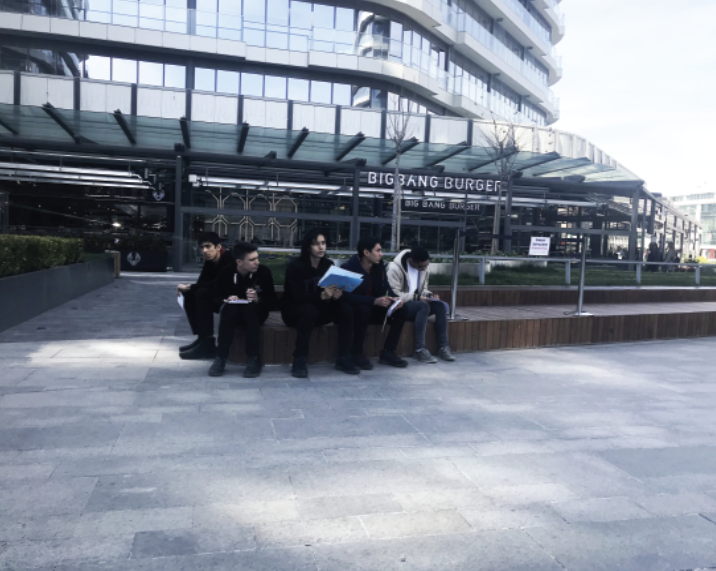
The program unfolds in five phases. In Sensory Activation, participants explore two urban spaces with distinct technical, contextual, and emotional qualities. During Dialogue Creation, they share observations and establish shared meanings through dialogue. In the Co-creation phase, groups define the musical characteristics of each place including its tonality, tempo, rhythm, and dynamic range. This leads to Skill Development, where participants compose and perform musical pieces that express each location’s shared identity. Finally, in Collective Connection, they translate their interpretations into visual designs, imagining urban spaces shaped by their collaborative insights. Through this cyclical process, sound becomes a catalyst for rethinking and redesigning place.



Main Goal
Sound of the Place empowers youth to explore, understand, and reimagine urban spaces through multisensory experience and music. By blending observation, listening, movement, and creative expression, participants become both attentive observers of their environment and active interpreters of its sensorial qualities. They transform spatial awareness into a shared creative act, revealing place not as a static setting, but as a living, felt experience.
Art Interfaces
Music composition, drawing, sculpting and performance.
Place/s
METU campus, the central gathering space of an eco-university campus, where academic and social life intersect. Shaped by natural landscapes and contemporary architecture, it reflects a balanced, integrated sense of place.
Maidan, an open-air courtyard framed by high commercial buildings and lively dining spaces, capturing the energy, consumption, and openness of urban life shaped by a liberal economy.
Story
Driven by a curiosity about the relationship between music and place, we selected two locations with clearly distinct characters from a rational and formal perspective. We also identified a set of theoretically grounded musical design indicators to guide the assessment of each place. While this framework helped orient participants and establish a shared language for dialogue on place musicality, it was only the starting point of the process.
As the exchange of ideas unfolded, emotions and shared experience emerged as central forces. The collective act of composing together led to the formation of strong affective assemblages, which in turn catalyzed collective creativity and fostered deeper connections among participants.
Twenty participants aged 15 to 17 had musical backgrounds, while the other twenty aged 18 to 21 brought skills in spatial design. Each working group was intentionally composed to include both competencies. This balance enabled the groups to function as largely self-managed teams, requiring minimal facilitation. Both the composing and spatial design phases were therefore led by the participants themselves.