encounters
Karşılaşmalar (appl. in 2023)
Historic urban areas are often approached through documentation and regulation, where preservation is primarily understood as the protection of physical fabric. Yet places such as the Ankara Khan region are not only architectural artifacts; they are historically layered environments shaped by culture, movement, memory, trade, and everyday life. We were motivated to question how conservation strategies might evolve if spatial experience, emotion, and embodied presence were placed at the center. How can heritage be understood not only as material continuity, but as lived and shared experience?
Encounters seeks to cultivate a deeper, more engaged relationship with the Ankara Khan region through embodied and creative exploration. By creating a dynamic and inclusive open learning environment, the program invites participants to freely express emotional and bodily experiences while engaging in critical reflection. Through interdisciplinary collaboration, it encourages participants to rethink place as a living system shaped by history, culture, environment, and human interaction. Ultimately, the aim is to inspire innovative approaches to place thinking and empower individuals to act as active stewards of their cultural and historical heritage.
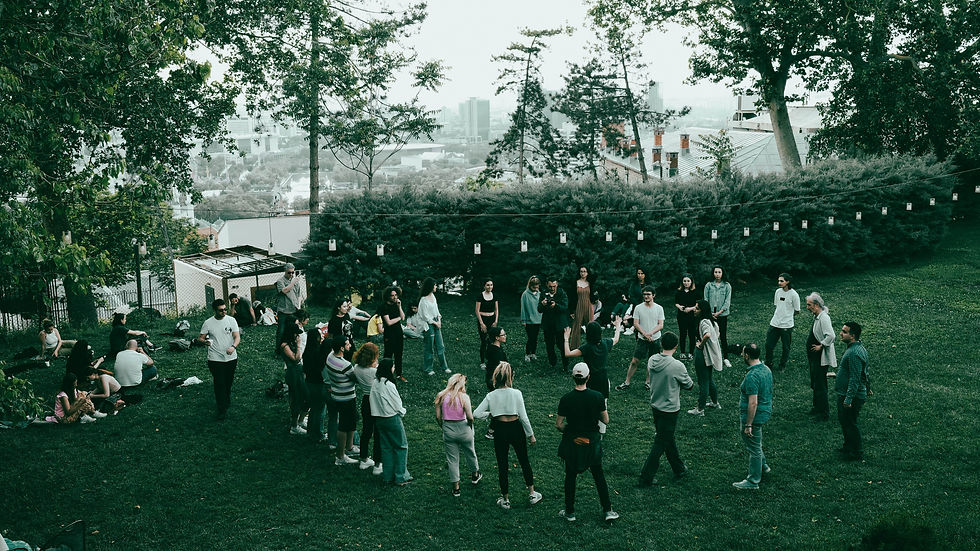
Encounters integrates music, movement, and video art as integral components of spatial experience. Rather than interpreting the site through detached observation, participants engage in collective movement and rhythm exercises on-site, transforming perception into embodied understanding. Music and dance become tools for reading the area’s historical, cultural, and aesthetic layers. These shared performative practices generate affective assemblages, moments where rhythm, emotion, and spatial awareness converge, deepening collective connection to place and revealing its constructed meaning. By merging performative arts with conservation discourse, Encounters reframes heritage as a relational and experiential field, extending preservation beyond the purely physical.
The program unfolds through five interconnected phases. In Sensory Activation, participants undertake a quiet expedition through the neighborhood, documenting individual impressions through attentive listening and observation. During Documentation, these experiences are shared and combined on a digital platform, forming a collective archive. The Search for New Expressions phase encourages exploration of artistic interfaces—poetry, drawing, photography, painting, music, and video—to articulate spatial and emotional responses. In Skill Development, participants engage in body movement and rhythm training to deepen embodied awareness. Finally, in Co-creation, they produce creative videos that capture both individual and collective reflections while exploring and vocalizing the site’s timbre under the guidance of a professional choir.
The program concluded at the Erimtan Archaeology and Art Museum, where participants presented manifestos, screened videos, and performed a contemporary dance inspired by the Khan region, engaging planners, decision-makers, and civil society in dialogue on embodied conservation approaches.




Main Goal
The Encounters integrates movement and rhythm into place experience to read the Ankara Khan region through embodied, affective engagement. By combining spatial exploration with performative practices, participants interpret the area’s historical, cultural, and aesthetic layers. These collective experiences deepen human connection to place and also inform locally grounded, meaningful conservation strategies beyond purely physical preservation.
Art Interfaces
Improvised body rhythm, creative video making.
Place/s
Ankara Hanlar Bölgesi, within Ankara, is a layered historic-commercial quarter where caravanserais, bazaars, and workshops have long structured everyday urban life. Its dense street fabric, courtyards, and mixed uses produce a lived ecology of trade, craft, and social encounter, sustaining memory and continuity amid rapid transformation pressures. Reading the area as an urban ecosystem foregrounds stewardship of heritage as active infrastructure, linking conservation to adaptive reuse, everyday economies, and inclusive public space.
Story
Historic sites are often examined through a predominantly rational lens that prioritizes form and function. Such approaches tend to overlook the socio-spatial becomings that animate these environments in everyday life, leaving physical preservation strategies insufficient to address the lived processes that sustain them.
Encounters responds to this gap by integrating music, movement, and video-making into place experience. Through collective movement, improvised body rhythms, and on-site engagement, participants connect with the everyday life of the place alongside its history, culture, environment, and aesthetics. Their embodied interpretations are translated into creative video expressions, forming a dynamic and inclusive learning environment.
By foregrounding creativity, exploration, music, and dance as integral to spatial experience, the project opens new ways of sensing, understanding, and reflecting on place. Through this interdisciplinary and participatory process, participants are encouraged to actively engage with, and take responsibility for, the cultural and natural heritage they inhabit.